REPORTEarth Observation in support of EU policies for biodiversity - A deep-dive assessment of the Knowledge Centre on Earth Observation 21/04/2023 Ispra, Italy (EC Joint Research Centre)Executive summaryThe European Commission Knowledge Centre on Earth Observation (KCEO) aims to maximise the uptake of products and information from Copernicus to support EU Policies in various sectors and translate policy needs into concrete requirements for products and services. It also aims to provide a forum for dialogue with the technical implementing entities associated with Copernicus and to raise awareness of next generation Earth Observation (EO) science and associated technologies to enhance the exploitation on Copernicus throughout the EU policy cycle.The deep dive assessments, focused on specific needs and use of EO in specific policy areas, are a mong the tools that the KCEO has put in place for enhancing the EO uptake in EU policies. The main objective of deep dives in KCEO is to analyse EU policy needs in a defined policy area, to verify whether existing EO products and services meet these needs, to highlight existing gaps and provide recommendations on future evolution of Copernicus products and services to address these needs.This report stems from the deep dive assessment of the KCEO focused on biodiversity policies, exploring how EO (mainly ground-based and from space) products and services can be used in supporting biodiversity related policies. Being the first deep dive exercise, it also serves as a test of the deep dive methodology.Read more
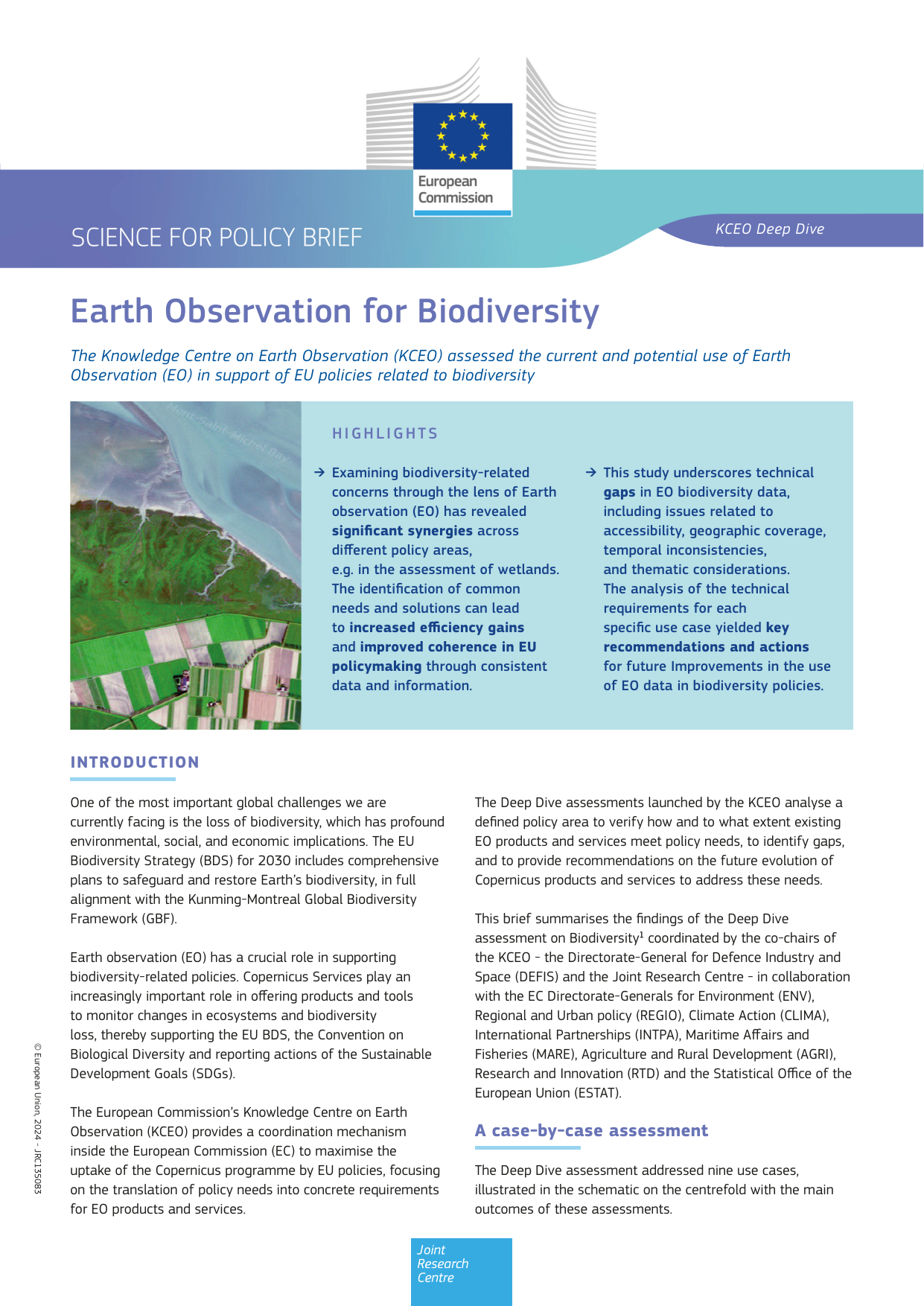
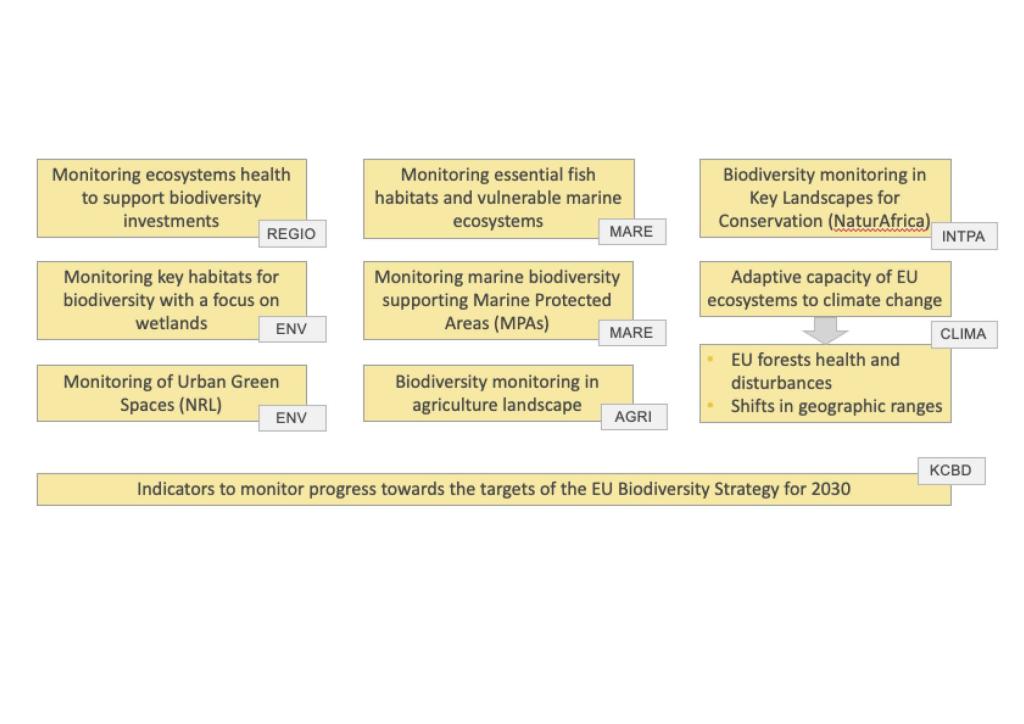
Policy briefEarth Observation for Biodiversity 2024 Science for policy Environment and climate change Abstract: The Knowledge Centre on Earth Observation (KCEO) assessed the current and potential use of Earth Observation (EO) in support of EU policies related to biodiversityThe KCEO DD assessment on EO in support of biodiversity-related policies, was rooted on the questions and policy information needs raised by the European Commission Directorate Generals and the implementation of the EU Biodiversity Strategy for 2030Examining biodiversity-related concerns using EO brought to light numerous synergies across different policy themesEO applications emerged to be crucial in monitoring and reporting in common policy contextsThe opportunities presented by the Copernicus products and services are therefore a potential to streamline and enhance EO uptake across EU policies areasAuthors: CAMIA Andrea; DOWELL Mark; VANCUTSEM ChristelleEditors: GLIOTTONE Ilaria; BERTOGLIO CamillaCitation: Camia, A., Dowell, M. and Vancutsem, C., Earth Observation for Biodiversity, Gliottone, I. and Bertoglio, C. editor(s), European Commission, Ispra, 2024, JRC135083.Date available: 2024-01-26Publisher: European CommissionJRC number: JRC135083URI: https://publications.jrc.ec.europa.eu Policy Brief Biodiversity Deep Dive Knowledge Centre on Earth ObservationEnglish(1.64 MB - PDF)Download
EVENTREPORTKCEO Stakeholder Workshop on Biodiversity and Earth Observation EVENT2022The workshop presented the findings of the deep dive assessment and brought together representatives from Copernicus Entrusted Entities and Partners, EU Member States institutions and agencies, the research community and the private sector.CONFERENCE REPORT2023The Knowledge Centre on Earth Observation (KCEO) aims to maximize the uptake of products and information from Earth Observation (EO) to support European Union (EU) Policies and to establish best practices to translate EU policy needs into concrete requirements for EO products and services.In this respect, KCEO runs thematic assessments analysing EU policy needs in selected policy domains with the ambition to verify how and to what extent existing EO products and services meet these needs, highlight existing gaps and provide recommendations on future evolution of products and services. The first deep dive assessment has been on EO and biodiversity and, as part of the process, a Stakeholder Workshop was organised by KCEO on November 16th, 2022.The workshop was intended to present the findings of the deep dive assessment and meet with representatives from technical implementing entities and partners associated with Copernicus, EU Member States institutions and agencies, the research community and the private sector. It was meant to discuss which EO products and applications are available from Copernicus to support EU policy needs regarding biodiversity, but also what existing technologies and opportunities are available outside Copernicus to address those needs. The outcomes of the workshop provided inputs for the biodiversity deep dive assessment and are summarised in this report.Links View event page Download report
NEWS | 11 Jun 2026 Commission presents first-ever EU strategies for islands and coastal communities Today, the European Commission adopted two dedicated strategies, one for EU islands and one for EU coastal communities, setting out for the first time a coordinated European... NEWS | 11 Jun 2026 Why a nature-positive economy is Europe's smartest investment Commissioner Jessika Roswall writes that restoring ecosystems can unlock billions in sustainable growth and resource security at the same time as mitigating severe climate risks. NEWS | 11 Jun 2026 European State of the Climate 2025 report published At least 95% of Europe experienced above-average annual temperatures in 2025, according to the European State of the Climate (ESOTC) 2025 report published today. Warming is reducing snow and ice... More
NEWS | 11 Jun 2026 Why a nature-positive economy is Europe's smartest investment Commissioner Jessika Roswall writes that restoring ecosystems can unlock billions in sustainable growth and resource security at the same time as mitigating severe climate risks. NEWS | 11 Jun 2026 European State of the Climate 2025 report published At least 95% of Europe experienced above-average annual temperatures in 2025, according to the European State of the Climate (ESOTC) 2025 report published today. Warming is reducing snow and ice...
NEWS | 11 Jun 2026 European State of the Climate 2025 report published At least 95% of Europe experienced above-average annual temperatures in 2025, according to the European State of the Climate (ESOTC) 2025 report published today. Warming is reducing snow and ice...